

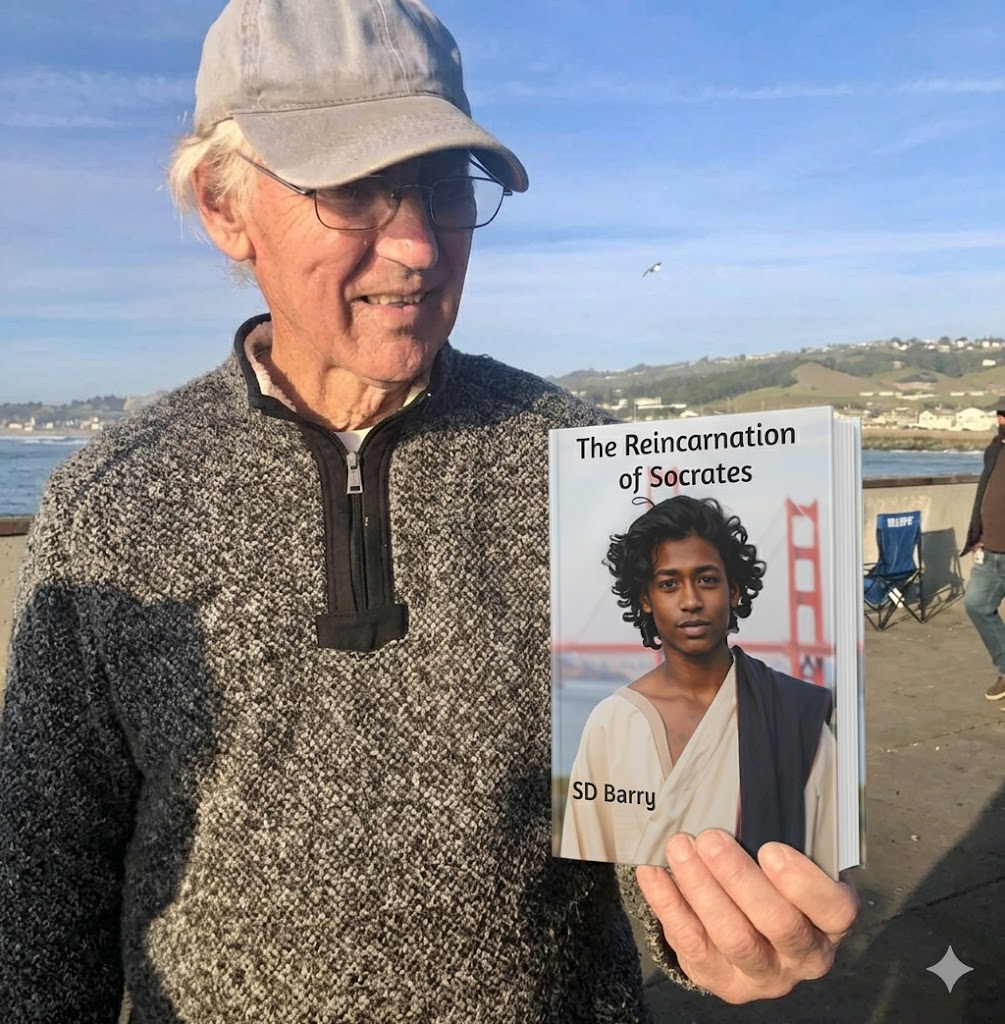
I grew up in San Francisco, attended college there in the 1960s, and earned a degree in Biology and Physics. Thereafter, I spent many years as a high school science teacher. Upon retirement, I decided to become a writer, but soon realized I lacked the education. My stories lacked depth. My wordsmithing was trite. A strong science IQ wasn’t enough. Thus began a years-long, ardent, and self-directed study of Philosophy, History, and Religion. My writing improved as my understanding grew. When I felt prepared, I wrote my first novel: In the Shadow of an Irish God, an award-winning story of a logical, rational fourteen-year-old boy struggling to survive a 1950s Catholic education. My latest novel, The Reincarnation of Socrates, follows a brilliant teenager attempting to emulate his namesake by creating and leading a group of high school peers in the art of profound inquiry. Both novels touch on deep issues informed by my after-retirement studies.
READ MORECome experience a year in the life of a fifteen-year-old genius named Socrates who proves that a ‘teen intellectual’ is not an oxymoron. “Sock,” as his high school friends call him, not only disproves the stereotype of the shallow teenager, but he also demonstrates his group’s intellectual talent to the teachers, parents, students, and administrators of his school. Teen girls and boys from places as disparate as San Francisco, Cambodia, Nigeria, Tennessee, Ethiopia, a foster home, a racist home, Vietnam, Juvenile Hall, and New York not only learn how to pursue understanding in the way of the original Socrates; they also have a blast doing it. Learning becomes their adventure. The reincarnation of Socrates is not presented as an imagined Buddhist dream; it is written as an on-the-ground reality in beautiful, noisy, foggy 1956-57 San Francisco.

Dive into the origins of Western philosophy with Socrates, Plato, and Aristotle.
Explore Stoicism, Epicureanism, Skepticism, and beyond.
Reinterpreting ancient wisdom in today's philosophical landscape.

Young Socrates, "Sock" to his friends, burns with contagious curiosity and a unique ability to parse complex concepts into simple parts. He leads a cohort of budding high school intellectuals into the world of philosophy. Every day at lunch, they meet for discussions that daily grow more profound. They visit teachers with their philosophical questions. They contend with other students who deride them as eggheads. They gather steam. They become a unit. They encourage each other's comprehension. By the end of the school year, they are an intellectual force, admired by parents, teachers, students, and their principal. Their passion for learning culminates in a large philosophy meeting at a San Francisco coffee shop, attended by Sock and his compatriots: two parents, two high school teachers, and two university professors. The adults are awestruck at the level of discourse. “These are high school students?” Young Socrates slays the oxymoron of the intellectual teen.
In the midst of their saga of inquiry, Sock and a couple of his friends embark on an adventure that culminates in the arrest of a local hoodlum. The novel ends with Sock and his group discussing crime, punishment, and the nature of justice.
Socratic Thought


Lorem ipsum dolor sit amet, consectetur adipiscing elit, sed do eiusmod tempor incididunt
Lorem ipsum dolor sit amet, consectetur adipiscing elit, sed do eiusmod tempor incididunt
Lorem ipsum dolor sit amet, consectetur adipiscing elit, sed do eiusmod tempor incididunt
Lorem ipsum dolor sit amet, consectetur adipiscing elit, sed do eiusmod tempor incididunt
Lorem Ipsum is simply dummy text of the printing and typesetting industry. Lorem Ipsum has been the industry's
Stay up to update with our latest news and products.
Copyright © 2026.All Right Reserved